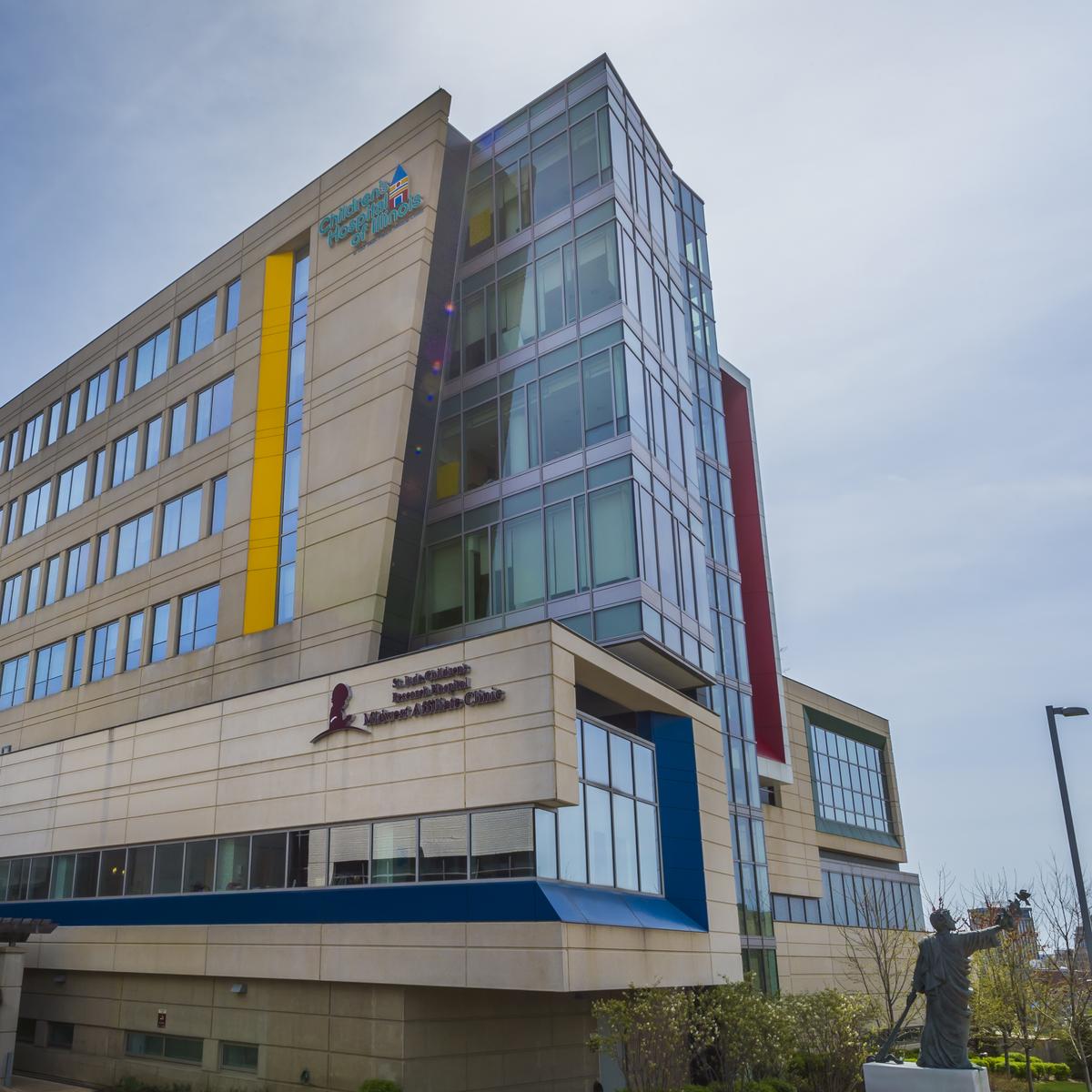
At the Congenital Diaphragmatic Hernia (CDH) Clinic at OSF HealthCare Children’s Hospital of Illinois, you can count on specialized expertise and highly coordinated care for children with this complex condition. Families trust us for a seamless, team-based approach that begins during pregnancy and continues into adulthood.
Congenital diaphragmatic hernia (CDH) is a rare birth defect where the diaphragm doesn’t fully form, allowing abdominal organs into the chest and affecting lung development. Its cause isn’t always clear but doctors believe it involves a combination of genetic and developmental factors during early pregnancy. CDH occurs in about one in every 3,030 births in the United States.
CDH is a complex condition, and learning the different types, how it’s diagnosed and how it can affect your child is the first step in understanding their care and preparing for the journey ahead.
CDH can occur in different parts of the diaphragm. Identifying the type of hernia helps the care team plan treatment and understand how it may affect your child’s lung growth and development.
There are two main types of CDH:
Most cases of CDH can be detected before your baby is born during routine prenatal ultrasounds. This early detection helps care teams plan for a safe delivery and coordinate specialized care after birth.
When a potential hernia is identified, maternal-fetal medicine (MFM) specialists can perform a more advanced evaluation with imaging to confirm the diagnosis and determine how severe it is.
As children with CDH grow, many go on to develop normally. Some may experience complications from CDH, including:
With close monitoring, early intervention and a coordinated care team, many children with CDH reach developmental milestones and go on to thrive.
At the CDH clinic, your child will be cared for by a team of experts who specialize in treating and repairing congenital diaphragmatic hernias. This team works together in one place, sharing information and making decisions as a group, so your child’s care is coordinated and centered around their whole health. Members of this care team may include:
As a member of the Congenital Diaphragmatic Hernia Study Group for more than 20 years and a designated ELSO Center of Excellence, our program delivers care informed by the latest research and national best practices. For your child, that means thoughtful, evidence-based decisions, access to advanced life-support therapies when needed and care in a Level IV NICU equipped to manage even the most complex CDH cases.
As part of the Vermont Oxford Network and the Children’s Hospitals Neonatal Consortium (CHNC), our NICU measures outcomes against not only national, but global standards to ensure we provide the highest quality of care. Through innovation supported by Jump Trading Simulation & Education Center, we continuously improve how we care for children with CDH, giving them the best possible outcomes today and in the future.
If your baby has been diagnosed with CDH during your pregnancy, the next step is connecting with a specialized care team. Your OB/GYN or maternal-fetal medicine specialist can provide a referral to the CDH clinic. Asking for a referral early will help you be prepared and connected to the right team from the very beginning of your baby’s journey.
Treating CDH often begins before your baby is born, where careful planning and world-class expertise come together to give your baby the strongest start possible.
From the first prenatal appointment through the critical early days after birth, every decision is guided by evidence-based care and leading-edge science, all delivered by a team whose expertise sets the standard for complex care.
If your child is diagnosed with CDH during your pregnancy, our maternal-fetal medicine specialists will coordinate care with your regular OB/GYN. You’ll have access to advanced monitoring and detailed ultrasounds to closely follow your baby’s development. Your care team will work closely with you to develop a delivery plan that prioritizes your baby’s medical needs while honoring your family’s preferences whenever it is safely possible.
Before they are born, babies with CDH are often evaluated by pediatric cardiologists to check for any heart differences and to understand how the hernia and organ compression may be affecting their heart and blood vessels.
After delivery, your baby will be cared for by a specialized team in our Neonatal Intensive Care Unit (NICU). The NICU at OSF Children’s Hospital of Illinois is a Level IV unit, which is the highest level of care in the region, for premature or critically ill newborns.
The NICU team works with your delivery team to ensure a smooth, seamless transition after birth. Your stay will include a private room with low lighting, a couch for caregivers and NicView cameras so you can check on your baby virtually, if needed.
Sleeping rooms and dining areas are available for families who need to stay close to their baby, as well as other nearby accommodations, such as the Ronald McDonald House and Family House .
The first priority after your baby is born is keeping them safe and stable. Because CDH allows abdominal organs to move into the chest, there is less space for the lungs to grow, so many babies are born with smaller lungs and need specialized breathing support in the first days of life. Some babies may require a breathing machine, and in certain cases ECMO, to support their heart and lungs while they stabilize.
ECMO is a specialized machine that temporarily does the work of your child’s heart and lungs. The machine takes blood out of your child’s body, adds oxygen and pumps it back in. Receiving care at a hospital equipped with ECMO is critical, as it provides an added layer of support for managing complex cases like CDH.
OSF Children’s Hospital is recognized as an Extracorporeal Life Support Organization (ELSO) Center of Excellence meaning your child will receive the highest level of ECMO care available.
Throughout your baby’s treatment, we work to ensure that care and medical support do not interfere with opportunities for bonding and breastfeeding. These connections are just as important to your baby’s growth and well-being as any medical intervention.
Once your baby is stable and ready, our surgeons will repair the hernia through a carefully planned operation. During the procedure, the organs that have moved into the chest are returned to the abdomen, and the opening in the diaphragm is closed. Small openings are usually closed with stitches, while larger openings may require a patch to provide extra healing support.
Your baby will stay in the hospital after surgery while our team supports their recovery. Because their lungs are still developing, many babies will need breathing assistance for a period of time or ongoing treatment after going home.
In the early stages of recovery, babies with CDH are unable to eat by mouth. Instead, they receive personalized IV nutrition called total parenteral nutrition (TPN), which is carefully formulated and adjusted each day to meet your baby’s specific needs. As your baby becomes more stable after surgery, small feedings through a tube into the stomach are gradually introduced and increased as they are able to tolerate them.
We strongly support breastfeeding and family involvement in feeding whenever possible. As your baby grows stronger, they will slowly transition toward feeding by mouth, and our team will guide you through each step of that process.
When possible, you will have opportunities to hold and bond with your baby, participate in their daily care and help guide progress as your baby is weaned from ventilators and other medical devices. This collaborative approach helps your baby grow stronger and support their development.
Before your baby is ready to go home, we’ll check to make sure their systems are working as they should. Your care team may perform:
After your baby leaves the hospital, ongoing follow-up care is an important part of their development. The CDH Follow-Up Clinic provides coordinated, multidisciplinary care tailored to your child’s needs at every stage.
Your baby will have regular appointments, especially during the first few years, to monitor growth, lung and heart function, nutrition and overall development. Each visit includes a thorough review of your child’s growth and development by a team that may include dietitians, physical therapists or speech-language pathologists. This team-based approach allows all aspects of your child’s development to be assessed in one place.
When additional care is needed, we work to coordinate appointments with other specialty providers, such as cardiologists or gastroenterologists, often on the same day. This “one-stop” approach helps reduce travel and minimizes missed work or school for your family.
We partner closely with your child’s primary care provider, as well as programs such as the Division of Specialized Care for Children (DSCC), early intervention and pediatric rehabilitation in order to provide therapy, developmental support and any specialized services your child may need.
As children with CDH grow, their medical needs may change. Planning for this transition is an important part of ensuring continued health and quality of life.
Our team works with you and your child to coordinate care with adult specialists and primary care providers, making sure medical history, ongoing therapies and medications are clearly communicated to everyone involved in your child’s care. We also connect families with additional support services and statewide programs that help young adults manage complex health needs, navigate insurance and access therapy or rehabilitation services as needed.
Learning that your baby has CDH can be difficult news, but it also opens the door for early, specialized care. Throughout your pregnancy, you’ll have regular imaging and consultations to monitor your baby’s growth and plan for a safe birth. We’ll connect you with pediatric specialists and work with you to create a care plan tailored to your baby’s unique needs, so you feel informed, supported, and prepared for the journey ahead.
The left side of your child’s diaphragm develops slightly later than the right, which makes it more vulnerable to defects. About 80–85% of CDH cases occur on the left side.
Yes. Some children with CDH may experience reflux, vomiting or other feeding challenges, which can sometimes lead to slower weight gain. Your care team includes dietitians who will work with you to manage these issues and help your child grow and thrive.
CDH occurs in about 1 in every 3,030 live births. While rare, specialized care improves outcomes and long-term development.